Netsync logoNetsync | Opportunity Zone Investment Command Center
Opportunity Zones 2.0 | Customer Brief for Cities & Counties

From tax geography to investable capital portfolio.

Opportunity Zones are not direct grant allocations to local governments. They are tax-incentive geographies intended to attract private capital into low-income census tracts. The local challenge is execution: turning designation into project pipeline, investor confidence, measurable outcomes, and defensible public accountability.

Executive takeawayThe map is not the asset.The asset is a living capital file: projects, risks, incentive stack, source evidence, and verifiable outcomes.

The practical issue

What cities and counties are really competing for

Not a fixed local grant check. The competition is for designation, investor attention, project feasibility, and the ability to prove public value after private capital starts moving.

1 | Positioning

State-nominated census tracts

Local teams need a defensible view of which tracts matter and why those tracts can produce investment outcomes.

  • Eligible tract registry
  • Policy and plan alignment
  • Local project evidence
2 | Capital

Private investment, not city revenue

The designation is a signal to investors. The city’s job is to reduce diligence friction and make real projects visible.

  • Sites, sponsors, and readiness
  • Capital gaps and timelines
  • Incentive-stack fit
3 | Proof

Local accountability

Even when the city does not directly receive OZ funds, leadership still faces the public question: what changed?

  • Jobs and wages benchmarked against BLS data
  • Housing, business, tax-base, and vacancy movement
  • Evidence for auditors and councils
Solution layer

The Capital Readiness Engine

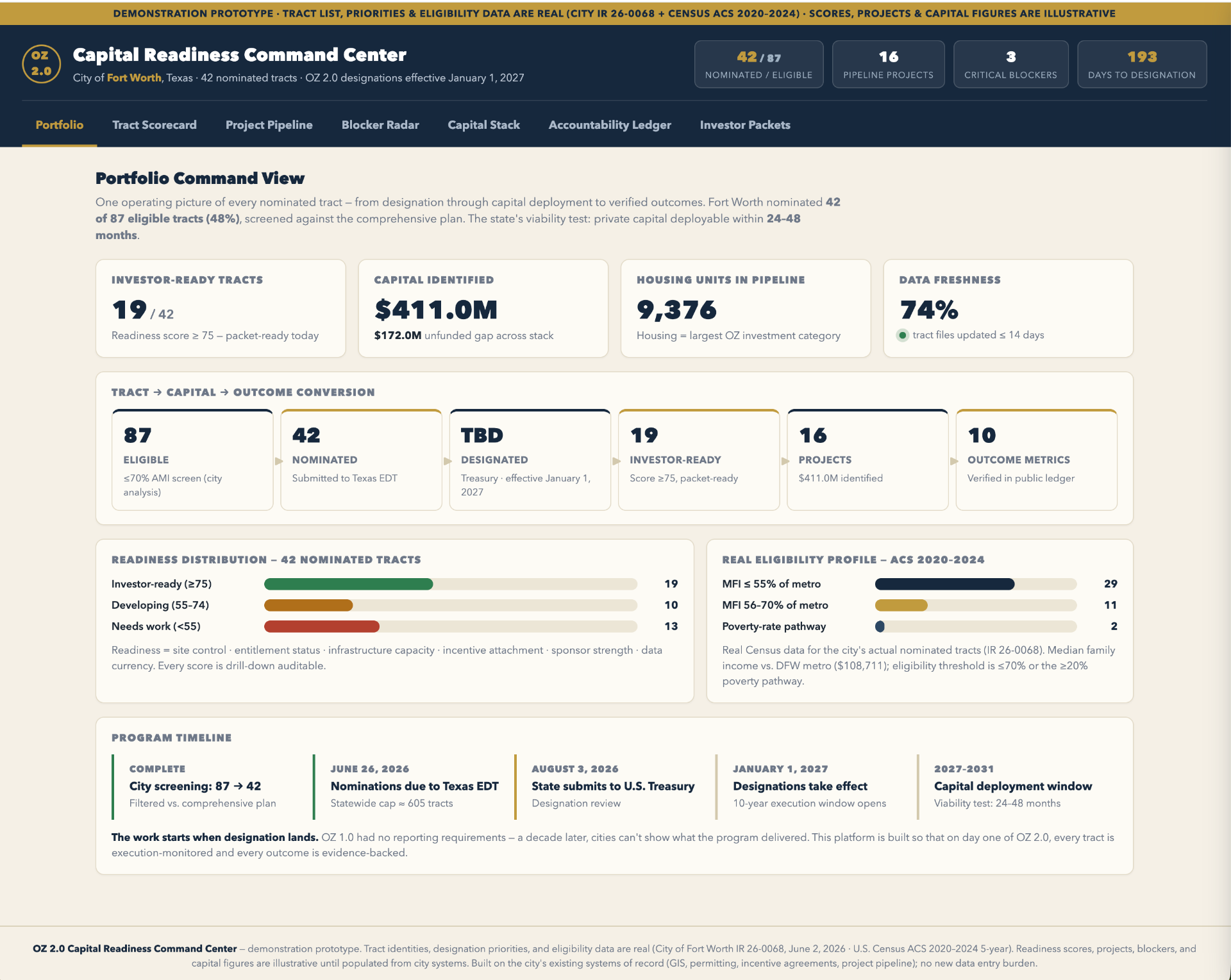
The solution sits above existing GIS, permitting, incentive, infrastructure, project, and outcome systems. It is designed to ingest public and city-authorized data, then turn it into dashboards, exception alerts, audit evidence, and investor-ready material.

Data ingestedRaw inputs
T
Tract + census dataEligibility, poverty, income, demographics, rural status, certified boundaries.
L
Land + local assetsGIS, parcels, ownership, zoning, future land use, public land.
P
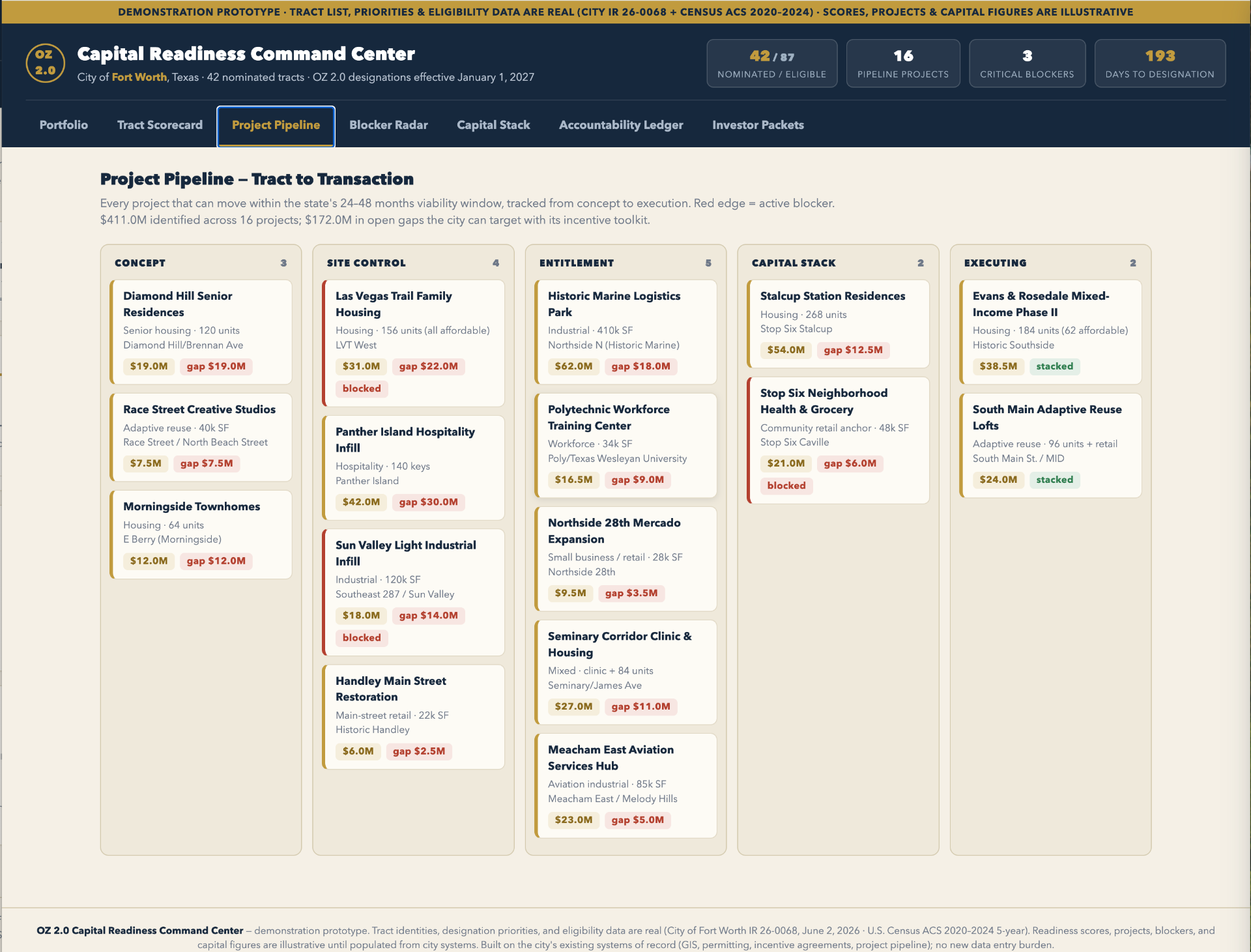
Project readinessSponsors, site control, permits, entitlement stage, capital gap, blockers.
$
Capital stackOZ, NMTC, LIHTC, TIF/TIRZ, PID, CDBG, EDA, USDA, brownfields.
R
Risk + infrastructureUtilities, roads, transit, broadband, floodplain, environmental records.
E
Labor + outcome intelligenceBLS labor and wage benchmarks, Census worker flows, project reports, housing, business starts, tax base, compliance proof.

Capital Readiness Engine

Connects tract → parcel → project → capital stack → blocker → outcome.

Capital Operating FileEvery tract and project becomes a source-backed operating record.
NormalizeClean tract, parcel, project, and program data into one model.
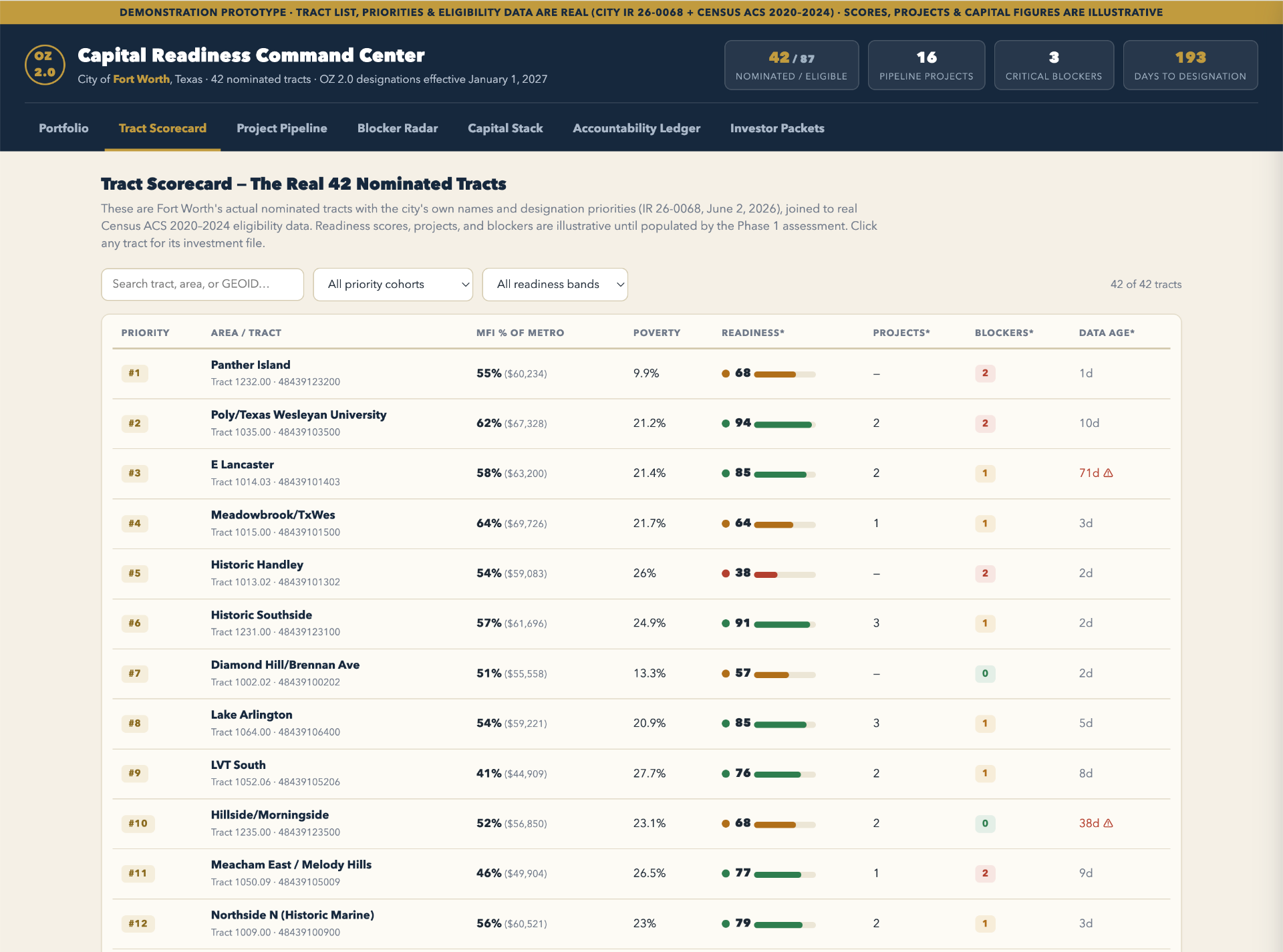
ScoreRank readiness, risk, incentive fit, and investability.
CorrelateLink public datasets, city-authorized source systems, and project evidence.
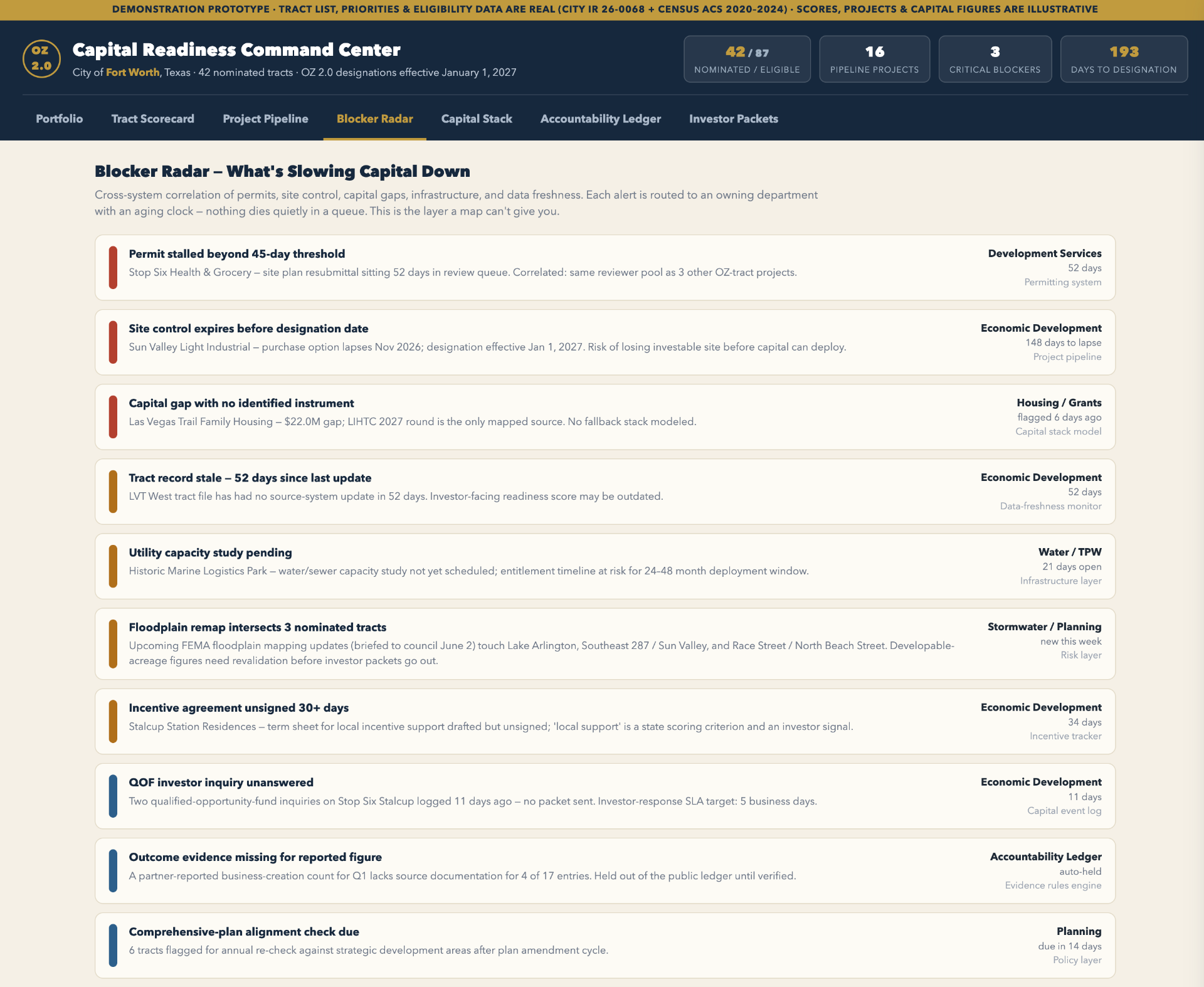
AlertFlag stale records, missing proof, aging blockers, and contradictions.
PackageGenerate dashboards, reports, investor packets, and audit files.
What it producesUsable outputs
C
City operating dashboardPortfolio view, tract status, project pipeline, owners, deadlines, blockers.
I
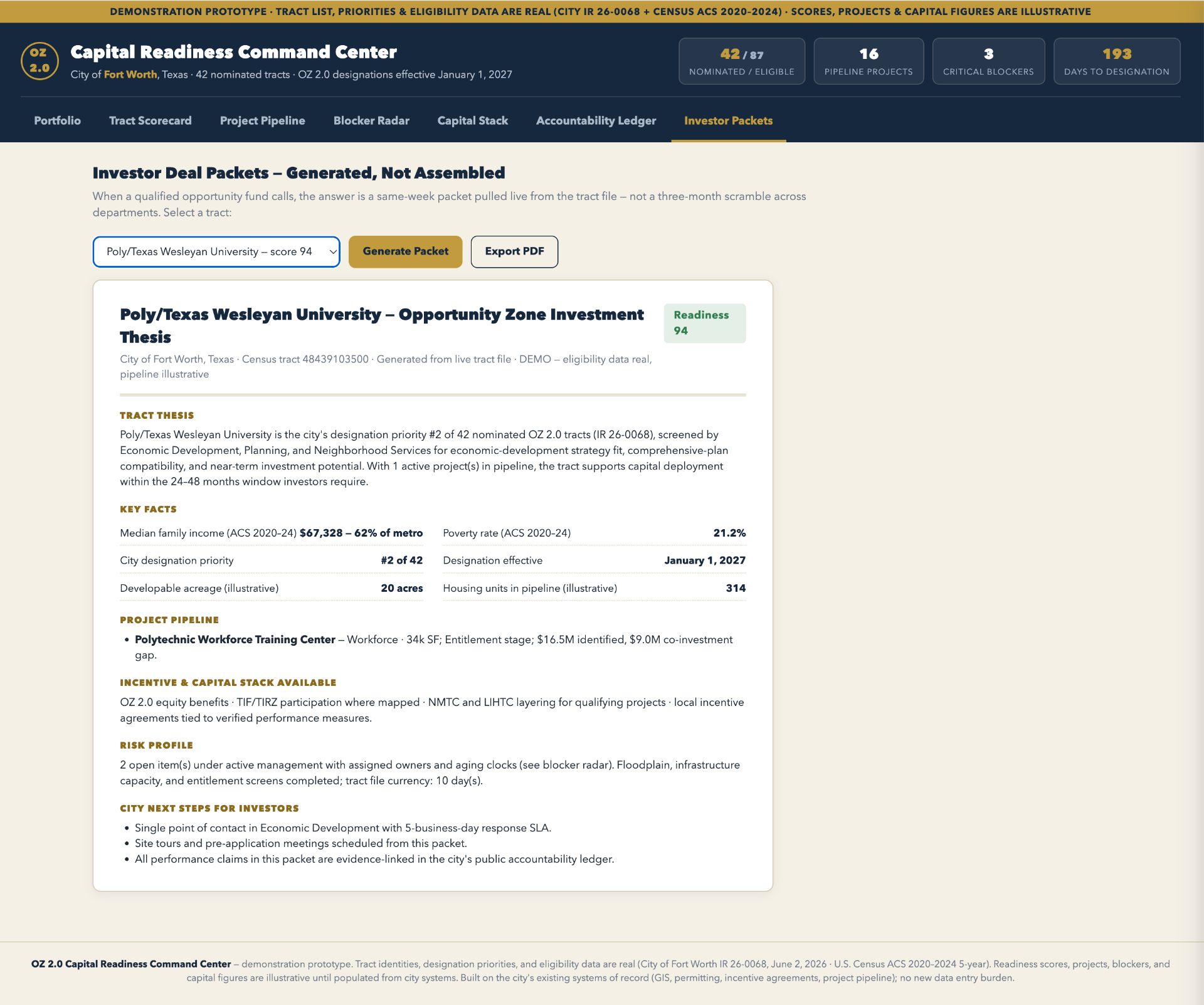
Investor-ready packetsTract thesis, project one-pagers, site risk, incentive stack, capital gap.
A
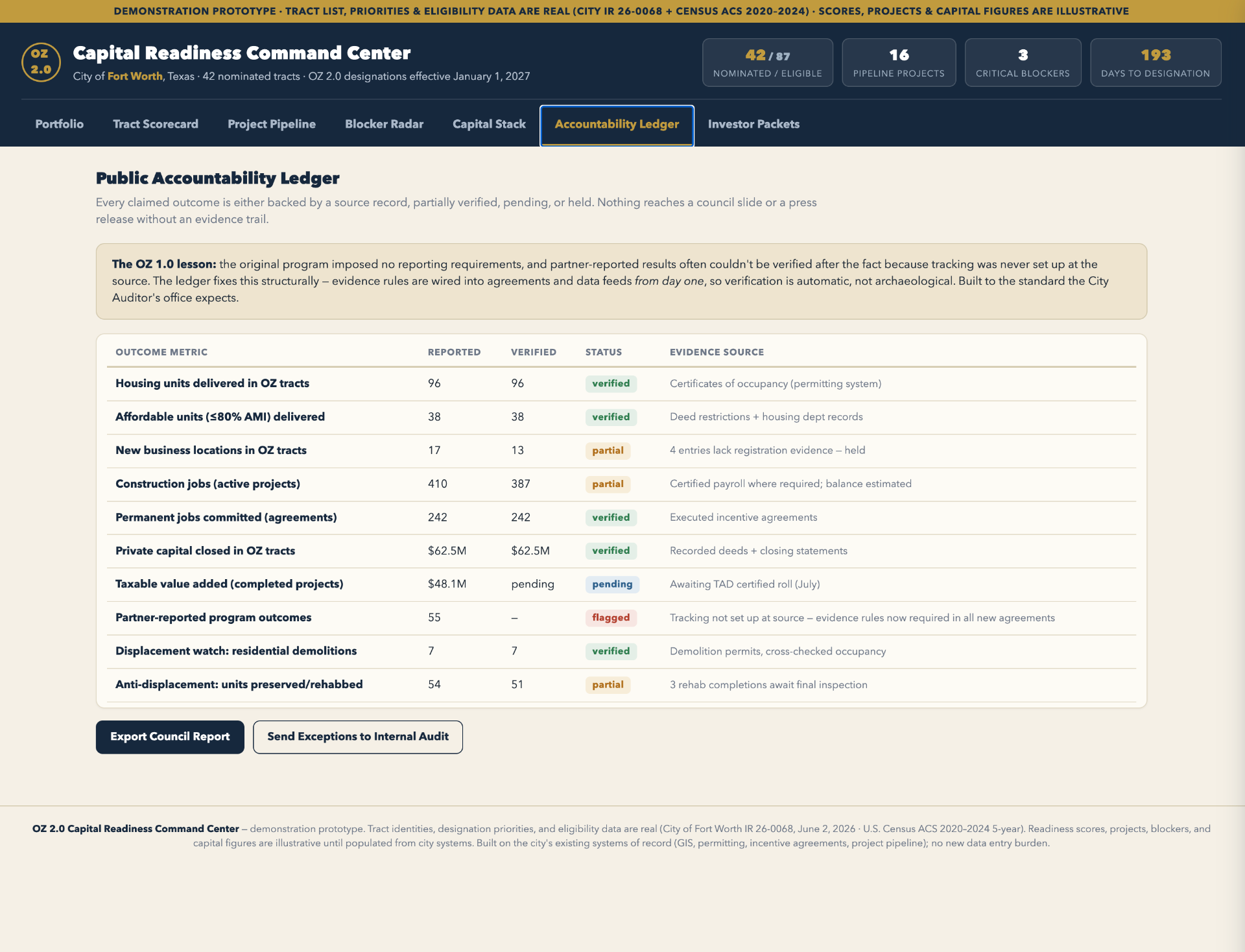
Audit + evidence ledgerVerifiable outcomes, definitions, source records, change history.
B
Blocker radarPermit delays, site-control gaps, utility constraints, stale records.
P
Portfolio strategyOZ plus NMTC, LIHTC, TIF, grants, brownfields, infrastructure.
R
Public reportingCouncil summaries, community benefit metrics, impact dashboard.
Value stack

Productivity is real. Capital conversion is the point.

Automating reports helps. The larger value is turning fragmented land, labor-market, project, incentive, and outcome data into investment-ready intelligence.

Productivity value

Less manual assembly. Fewer stale files.
  • Reusable tract and project records
  • Faster council, state, and investor responses
  • Automatic flags for stale or missing information
  • One source of status across departments

Capital investment value

More credible projects. Faster diligence.
  • Investor-ready project files instead of static maps
  • Clear capital gaps, incentive layers, and risks
  • Earlier visibility into permitting and infrastructure blockers
  • BLS/Census benchmarks plus local evidence for public-benefit claims
Data gap

Selection-grade data is not investment-grade data

Most teams can assemble enough information to nominate tracts. Investors, executives, and auditors need a different file: one that shows whether the tract can absorb capital, move projects, benchmark jobs and wages, and verify outcomes with evidence.

QuestionNomination fileCapital fileWhy it matters
Is the tract eligible?Census and Treasury criteria.Persistent tract registry with source data and change history.Baseline compliance and defensible public record.
Is there a real project?Staff notes, public feedback, known opportunities.Sponsor, parcel, site control, stage, cost, gap, and timeline.Investors underwrite projects, not geography.
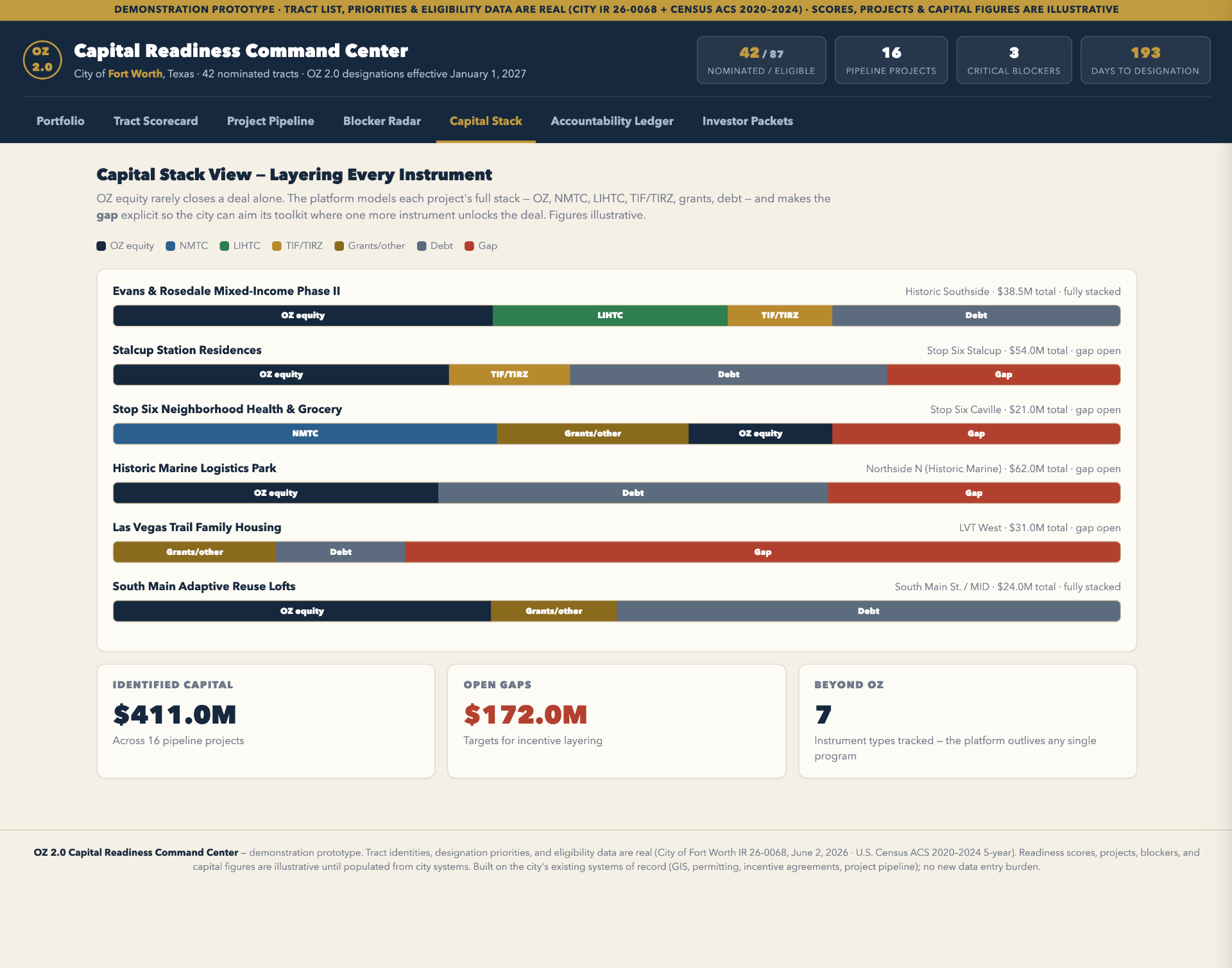
Can capital stack?Known incentive overlays.OZ, NMTC, LIHTC, TIF/TIRZ, grants, brownfields, and local incentives tied to each project.Layered capital can make marginal projects financeable.
What can block execution?Manual follow-up with departments.Zoning, permits, utilities, floodplain, environmental, ownership, and political risk register.Risk found early can be managed. Risk found late kills deals.
Can outcomes be proven?After-the-fact reporting.BLS and Census labor benchmarks, city-authorized project data, sponsor evidence, outcome definitions, owner, timestamp, and audit trail.Benchmarks create context. Evidence verifies claims.
Often-missing sources

Information many teams do not consistently combine

The value is not knowing where Opportunity Zones are. The value is connecting land, infrastructure, incentives, market demand, labor-market benchmarks, project readiness, and outcome evidence that usually live in separate systems.

Ownership + control

Shows whether an opportunity can actually transact.

  • Appraisal district ownership
  • Deeds and encumbrance clues
  • Tax delinquency and public land
  • Ownership fragmentation

Readiness + entitlement

Shows whether a project can move without delay.

  • Zoning and future land use
  • Permits and platting
  • Certificates of occupancy
  • Code violations and demolition

Infrastructure + risk

Shows hidden cost and schedule blockers.

  • Water, wastewater, stormwater
  • Electric, broadband, roads, transit
  • Floodplain and environmental records
  • CIP and utility project timing

Capital + labor demand

Shows whether the project has a financeable thesis.

  • NMTC, LIHTC, TIF/TIRZ, PID, CDBG, EDA
  • BLS QCEW, OEWS, and LAUS benchmarks
  • Census LEHD/LODES worker flows
  • Vacancy, comps, leakage, anchors
Investor attraction

What investors need that a tract map cannot provide

Investors do not fund census tracts. They fund projects, sites, businesses, and sponsors. The Command Center turns each tract into a risk-adjusted investment thesis.

Capital conversion, not map publication
1
Tract investment thesisWhy this geography has a credible demand, policy, and incentive story.
2
Project one-pagerSite, sponsor, stage, cost, capital gap, timeline, and local contacts.
3
Risk profilePermitting, zoning, infrastructure, floodplain, environmental, and ownership blockers.
4
Incentive stackOZ plus NMTC, LIHTC, TIF/TIRZ, grants, brownfields, and local tools.
5
Evidence trailHow jobs and wages are benchmarked, and how housing, business creation, tax-base movement, and community benefit will be verified.
Outputs

What the tool produces for a city or county

One data spine can serve Economic Development, Finance, auditors, planning, housing, elected officials, public stakeholders, and investors.

Operating intelligence

Tract portfolio, project pipeline, owner view, deadlines, blocker radar, and data freshness alerts.

Capital readiness

Project readiness score, capital gap, incentive-stack map, risk profile, and investor packet.

Accountability layer

Outcome definitions, BLS/Census benchmarks, local verification sources, audit trail, council reports, and public dashboard.

Portfolio expansion

The same model scales across OZ, NMTC, LIHTC, TIF/TIRZ, CDBG, EDA, brownfields, and local incentives.

Buying committee

Who should care

This is not an IT-first problem. Economic Development owns the execution challenge; Finance and the Auditor own the evidence problem; IT and GIS enable integration.

Economic DevelopmentOwns tract-to-project execution, investor conversations, and capital readiness.
Finance / CFONeeds defensible evidence that incentive-adjacent activity creates public value.
Auditor / OversightNeeds definitions, evidence sources, and a reliable audit trail from the start.
IT / GISEnables integrations and data quality without carrying the business case alone.
Starting point

90-day execution-readiness pilot

A practical pilot proves the operating model, produces investor material, and creates the accountability spine for the broader community investment portfolio.

01

Build the registry

Load the public baseline first: eligible/designated tracts, Census/BLS labor indicators, incentive overlays, and risk layers. Then connect city-authorized parcels, zoning, projects, sponsor contacts, and source owners.

02

Score readiness

Rank tracts and projects by site control, entitlement status, infrastructure, capital-stack fit, sponsor maturity, risk, and timeline.

03

Generate materials

Produce dashboards, project one-pagers, tract investment theses, risk registers, and owner views for city teams and investors.

04

Set evidence alerts

Define metrics, benchmark sources, verification evidence, change history, stale-data thresholds, missing-proof alerts, and leadership reporting templates.

Netsync can help turn a tract portfolio into a managed capital pipeline.

Netsync helps cities, counties, and regional economic-development organizations connect public datasets with city-authorized local systems to build the investment intelligence they need: tract status, project readiness, incentive stack, blockers, investor materials, dashboards, and outcome evidence.

Start with public data. Add local source systems and project evidence. Move from a static OZ map to investor-ready projects, actionable dashboards, and defensible results.

Source notes

  1. Opportunity Zones purpose and structure: IRS, Opportunity Zones. The IRS describes OZs as an economic development tool intended to spur growth and job creation in low-income communities while providing tax benefits to investors.
  2. OZ 2.0 designation cycle and nomination process: IRS News Release IR-2026-45, Treasury, IRS guidance to states for nominating census tracts. Local governments should verify current state-specific nomination rules and final Treasury certifications.
  3. NMTC adjacent capital stack: CDFI Fund, New Markets Tax Credit Program. NMTC can be relevant where projects need layered financing through CDEs and private investors.
  4. LIHTC QCT/DDA overlays: HUD USER, Qualified Census Tracts and Difficult Development Areas. These designations are relevant to affordable-housing feasibility and broader capital-stack analysis.
  5. Labor-market benchmarks: BLS, Quarterly Census of Employment and Wages; BLS, Occupational Employment and Wage Statistics; BLS, Local Area Unemployment Statistics. These sources support employment, industry, occupation, wage, and labor-force benchmarks.
  6. Worker-flow context: U.S. Census Bureau, OnTheMap and LEHD Origin-Destination Employment Statistics. These sources support where workers live, where jobs are located, and commute/workforce-flow context.
  7. Verification note: Public BLS and Census data are benchmark sources, not automatic proof of project-level job or wage creation. Project-level verification requires city-authorized records, sponsor reporting, compliance evidence, or other approved evidence sources.
  8. Implementation note: This page is an informational overview, not legal, tax, or investment advice. Local governments should verify program guidance with counsel and state/federal administrators.